All posts by Maxwell Makumucha

How to start an ECD or Creche in Zimbabwe

How to start an ECD or Creche in Zimbabwe

Here is step by step guide in starting an ECD /Creche day – care center in Zimbabwe. 

If you like taking care of the young ones, you can make extra dollars by making use of your empty space at home by starting an ECD /Creche day – care center in Zimbabwe. A you expand, you can consider rented premises. When parents choose a daycare for their children, they look for a place that will enrich and keep their children safe during the day. While your daycare may have those qualities, without the right advertising and marketing, it will go overlooked.

ECD or Creche Students

ECD or Creche Students

You might try a few new strategies to catch the attention of parents and attract new clients to your daycare.

Register your ECD.

Check the registration requirements here…
It is mandatory to register an ECD .There are some requirements needed to register an ECD .These include but not limited to
1.Permission from Local authority to establish an ECD centre
2.Health certificate
3.Memorandum of understanding
4.Proposed names of the ECD centre
5.Physical address of the ECD centre
6.Area to be served by the ECD centre
7.Number of pupils to be enrolled on opening of age and ranges note : one teacher to 20 pupils
8. Name and qualification of teachers to employed
9.Medical certificates plus x-ray is a mandatory since you will be dealing with kids and health status of staff needs to be known
10.Floor plan and house plan
11.Title deeds or lease of agreement
12.Indoor play space area 1:2,25 square meters per child .Age appropriate furniture
13. Outdoor play space 1:5,5 square meters per child
14. Toilets closets 1:2
15.Wash basins

From the data we have gathered, the average startup cost for a daycare centre in Zimbabwe is $1000 to $2500.This can vary widely depending on whether you are opening a home-based daycare center or leasing a separate facility for your care centre .If don’t have $10000+in  bank  account  ,they don’t worry.


Ten tips to start an ECD or Creche in Zimbabwe and be successful :

1.Keep your environment safe and clean-Keep all doors secure .Ideally , have a code available only to parents and staff .Change it regularly.Ensure windows are securely fastened.All stairwells should be gated .Staff and children should wash hands throughout the day..This is especially true before meal times and after diapering /restroom use.Disinfect toys daily.Schedule a time so this task  is not forgotten  .Have a clear routines incase of emergency.
2.Make consistent policies- Clearly outline your policies to protect your business and address parent concerns.Maintaining a regularly updated  parent handbook can make your childcare center stand out  from others.Before enrolling , have parents review and agree to the policies listed in your handbook.Your can also add  your own unique policies .Consider addressing policies about ;hours of operation daily schedule
-displine
-food and nutrition
-sick-child
-feeding
-curriculum {[ more on this later}
-safety/cleanilises
-sleeping
-pick -up{who can pick-up the child ? how do you verify identity
-parent communication
-fees and payment
-immunisation
-program closing
-emergencies
3 Invest in training of your staff – babies and toddlers needs consistent , predictable care.For this reason , parents prefer childcare centers with low turnover.Invest training and resources in your staff.Treat them as respected ,appreciated professionals by ;recognizing and rewarding success and hard work
-providing support amd extra help when its neede
-holding a staff appreciation day/ week
-including staff in your vision goals ,  policies
-building relationship goals
4 Develop a curriculum – parents want to know that their children aren’t watching tv or sitting around all day.Young children need active play , stimulation , and learning .Think about programming and your daily schedule .
5. Communicate – to maintain and continue boosting enrollment , communication is key.Parents want to know what their child is up to throughout the day.Some daycare centers even have apps that allow them to share  information about meals, naps , and activities in real time.
Ten tips to manage a creche
1. Have clear policies and follow them-running successful daycares starts with having a clear set of policies .These policies need to apply to both children and parents .
2. Don’t take your friends and family kids- family and friends may expect special treatment regarding your policies .Avid this situation entirely and keep your business professional
3.Always ask for parental feedback-the most successful day care have  myriad of reviews  available on google
4.Have a social media presence – when you are  trying to look up local business information , what is one of the most common places you stop? Get assistance with professional social media management from City Cloud. Check their services here
5.Add value with unique services- look around at your fellow daycare providers to see what they offer .Various daycare centers may have their unique  take on the field.
6. Having a properly trained staff who believes in your vision-child care  businesses may be encouraged to save money by hiring staff that lack experience. However you run the gp of having an educational gap and safety exposures in this case.
7. Don’t forget to take a vacation-business owners who handle their own time typically forget that managing daycares can be an exhausting experience.
8.Simply the business side of things-many times  the business side of daycare can prevent owners from properly focusing.
9.Try to be flexible (within reason)-your parents will appreciate flexibility in their day cares , as some situations may prevent them from arriving on time.
10.Change upfront-while we hate to see it , there is always a chance for flaky parents  who won’t pay you.If they can get a month of free day care out of you straightforward for them to vanish

What’s stopping you from fulfilling your dreams and aspirations? Imagine being your own boss, being able to play an integral role in the development of your beloved country, empowering families and communities through your hard work. The decision is up to you. You have the power to make it happen. Contact us today and we’ll help you register your ECD or Creche business today!

Company Registration in Zimbabwe

What is Company Registration in Zimbabwe?

Company registration in Zimbabwe is the process of incorporating (registering) a business in Zimbabwe either as a Private Limited Company (PLC), Private Business Corporation (PLC) or any other business entity as stated in the Companies and Other Business Entities Act (Chapter 24:31). When a company is incorporated, the business becomes a separate legal entity; separate from its owners. The business becomes an individual ‘person’ in the eyes of the law. Essentially, this means that the company is completely separate from its owners in terms of finances, liabilities, contractual agreements, and ownership of property and assets.

Benefits of registering your own company

  1. Limited liability
  2. Legitimacy and brand awareness
  3. Easier to raise capital
  4. Supplier arrangements
  5. Low Tax Liability
  6. Business continuity

Our Company Registration in Zimbabwe service

Types of companies

They are quite a number of companies but the two most popular companies you can register in Zimbabwe are a Private Limited Company and a Private Business Corporation.

Private Limited Company (PLC)

A Private Limited Company is the most common company structure in Zimbabwe.Private limited company is a type of organisation you can set up to run your business.Company ownership is split into shares owned by shareholders.A company must pay corporation tax out of any profits and can then distribute the remaining profits among shareholders.
Private Limited Company requires at least 2 directors and a maximum of 50 directors and also limits the number of shareholders to 50.

Private Business Corporation

A Private Business Corporation is an alternative company structure to a private   limited company that is registered with the Companies registrar of companies in Zimbabwe- through the process of incorporation.

Requirements for company registration in Zimbabwe

There are 4 requirements when registering a company in Zimbabwe:
  1. Company name – should not be similar to an  already registered company, or which is so similar to any such name as to be likely to deceive, is likely to mislead the public, is blasphemous or indecent or likely to cause offence to any person or class of persons, suggests patronage of the Government or some other authority or organisation unless the consent thereof has been obtained, is undesirable for any other reason.
  2. Director’s information – Name(s) and surname as shown on government issued identity documents, national identity number/passport number, official address and former names. This information is shown on the CR 6.
  3. Shareholders information – name(s) and surname as shown on government issued identity documents and official address. This information is shown on the Memorandum and Articles of Association.
  4. Company objectives: These are the commercial activities the company is going to run the business. A company can have as many company objectives as they require. Sample objective can be farming, mining et..c.

Procedure for company registration in Zimbabwe

There are five important steps to the initial company registration procedure in Zimbabwe which include:

1.Name Search and reservation

With us,  you have to give us 5 proposed name and the one which is approved will be the name of the company. This can be done within 24 working hours with the approved name being reserved for up to 3 weeks from the application date. You can however further reserve the company name if it has expired.
2.Appointment of company directors
This is done through the CR 6 form  and is usually prepared by your consultant. A director should be above the legal age of 16 years, and at least one being ordinarily a resident of Zimbabwe. The individual must also not have been previously disqualified from acting as a director or bankrupt.
3.Appointment of company secretary(s)
This is also done through the CR 6 form .A company secretary should be above the legal age of 16 years, and ordinarily a resident of Zimbabwe. The individual must also not have been previously disqualified from acting as a company secretary.
4.Registering of company addresses
This is done through the CR 6 . The addresses should be a physical address which should be a Zimbabwean address, postal address and email address.
5.Company incorporation
The official company registration documents are submitted at the Companies Registry for incorporation. This is done only through a registered consultant, registered with the Deeds, Companies and Intellectual Property by (DCIP). After successful submission of the registration documents at the Companies Registry, the company is incorporated.

Documents you receive after registering a company in Zimbabwe.

The company documents you will receive will differ with the type of company you choose.
For a Private Business Corporation you will receive the following documents:
  • Certificate of incorporation – a legal document issued by the Registrar of Companies showing that your company has been approved
  • CR 28
For a Private Business Corporation you will receive the following documents:
  • Certificate of incorporation
  • CR 5 (Former CR 6) – List of company addresses
  • CR 6 (Former CR 14) – List of company directors
  • Memorandum of Association –  a legal statement signed by all initial shareholders or agreeing to form the company. It also shows the businesses objectives.
  • Articles of association – written rules about running the company agreed by shareholdeor guarantors, directors and the company secretary

Company registration prices in Zimbabwe

Our company registration prices .
  • Private limited company for $150
  • Private business corporation for $120
  • PRAZ for $120
  • Change of directors from $70
  • Tax clearance for $80
  • Name search for $10

Tax clearance

The law requires that a company registers with the Zimbabwe Revenue Authority (ZIMRA) within 30 days of starting to trade. Once you register, you will be issued a tax clearance.

Trade name registration

After registering your company, you may wish not trade with your official company name for different reasons. You can use an assumed name popularly known as a trade name. However, since the introduction of the Companies and Other Business Entities Act (Chapter 24:32) all trade should also be registered.

Our bank account opening service

Key authorities and legislation to be aware of:
The main corporate legislation in Zimbabwe is contained in the Companies and Other Business Entities Act (Chapter 24:31). The company should also be aware of the following local authorities when doing business in Zimbabwe.

Set up for success

Zimbabwe might be facing economic challenges but take note that Zimbabwe is one of the easiest countries to start up a business. Better still, it helps to work with a trusted partner that has in-depth knowledge of Zimbabwe’s regulations to help smooth flow of your company registration process whilst you focus on your business.

Talk to us

Company registration in Zimbabwe  can help you navigate all corporate secretarial hurdles. Whether you are registering a company in Zimbabwe or something else, Company Registration in Zimbabwe has a team of gurus with extensive local knowledge covering business establishment, corporate secretarial, tax compliance, advisory and other regulatory requirements.
How can we help you?
To discuss how Company Registration in Zimbabwe can help you with registering your company, call, WhatsApp, text or complete our contact form  and one of our experts will contact you.
Call
Mob: +263716196475
Mob: +263777069078

National Youth Day Promo

desert, children, sand-7008952.jpg

Calling upon all Zimbabwean youths aged 35 and below to come and grab this golden opportunity! From 18-28 February 2021, you will get huge discounts from any of our service offerings. Call us now for more: +263716196475

When is Robert Mugabe National Youth Day?

Robert Gabriel Mugabe National Youth Day is a national holiday in Zimbabwe and is celebrated on February 21st.

This holiday honours, Robert Mugabe who was the first prime minister of Zimbabwe from independence in 1980 until 1987, then the country’s 2nd president from 1978 to 2017.

The focus of the day is increasingly moving away from the late president and is instead focusing on youth. Speaking in 2021, Youth, Arts, Sports and Culture minister Kirsty Coventry, said “The 21st February is a National Youth Day. The day was proclaimed and instituted by the government in 2017 in order for the nation to recognise and celebrate the contributions made by the youth throughout the history of the country as well as for the young people to recognise and emulate the leadership values.” It is against this background that we want youths to lead in formalising their businesses, to lead in being employers of tomorrow that’s why we are giving them massive discounts on company registration. 

History of Robert Mugabe National Youth Day

Robert Mugabe was born on February 21st 1924. He was a school teacher before becoming involved in African nationalist protests calling for independence for Southern Rhodesia from Britain. He was imprisoned from 1964 to 1974 for making anti-government comments. On release, he became the leader of the ZANU Patriotic Front. He took part in the peace negotiations that led to independence and the end of minority white rule.

At the 1980 general election, Mugabe led the ZANU-PF to victory, becoming Zimbabwe’s first Prime Minister from 1980 – 1987. In 1987, he became President, only stepping down in 2017 after a military intervention and mass demonstrations.

Mugabe died on September 6th 2019 at the age of 95.

The Robert Gabriel Mugabe National Youth Day was first proposed and accepted in August 2017 after intense lobbying by the ZANU-PF Youth League.

The 21st February Movement was formed in 1986, by the ZANU-PF Youth League, to commemorate the principles and ideals that former president Mugabe stood for.

It was officially declared as a public holiday on the inauguration of President Emmerson Mnangagwa on November 27th 2017. On announcing the holiday, President Mnangagwa said the former president needed to be given the respect and recognition he deserved as one of the founders and leaders of Zimbabwe. “To me personally, he remains a father, mentor, comrade-in-arms and my leader,” he said.

May all those below the age of 35years engage us and get a lucrative percentage from any of the services we offer. 

How to open a Company bank account with First Capital bank

01


INTRODUCTION

How to open a corporate or company bank account with First Capital bank

Here are requirements to open a company bank account with First Capital Bank

1. Certificate of incorporation – bearing the registrar of companies

2. Memorandum and articles of association –registrar stamp on both copies

3. Company registered address document for registrar-registrar ‘s stamp

4. List of company directors from registrar-must bear the registrar’s stamp –names to agree with

identification documents

5. For a company registered after 15 February 2020 a beneficial ownership declaration form (cr16)

6. current tax clearance certificate from the tax authority

7. identity documents ( valid passport , national id card , driver’s licence) and proof of residential

address( utility bill less than 3 months old ) of all signatories.

8. Identity documents ( valid passport , national id card , driver’s licence ) and proof of a

residential address ( utility bills less than 3 months old ) for all executive directors. For non –

executive directors provide date of birth, place of birth , id number and residential address

9. Identity documents and proof of residence for shareholders with 10% shareholding and above

(i)if corporate body, provide registration number , registered address, registered name and date

of registration (ii) if individual provide ,passport , or id or driver’s licence and residential

address confirmation.

10. Fully completed application form

11. Appointment of bankers

12. Shareholders organogram showing ultimate beneficiary owners – management structure

13. Latest financial statements – #12 months projections ( cash flow statement ,balance sheet and

income statement

14. Company profile

15. Their email address Charles.gadaga@firstcapitalbank.co.zw

Kindly take note that for item #6, Current Tax Clearance Certificate, you have to use a bank advice note which we can issue to you for USD 20. Contact us: +263716196475 or +263777069078 , email address is info@companyregzim.co.zw . For assistance with any other documents and bank account opening, please do not hesitate to contact us.

Requirements to open a corporate bank account with Ecobank in Zimbabwe

BANK OPENING REQUIREMENTS

Here are the requirements to open a corporate bank account with Ecobank in Zimbabwe.

1. Completed account bank opening form

2. Fully signed mandate card

3. Dully signed mandate resolution

4. Memo and articles of association

5. Cr14 and cr6

6. Cr2 or letter confirming shareholding (signed by company secretary and a director)

7. Tax clearance form

8. Vat registration

9. Signatories (a) 1passport size photos(b)certified copies of id(c)proof of residence {not more than

3 months old} foreign nationals to provide extract of passports work permits and residential

permit

10. Certificate of incorporation

11. Directors –(a) certified copies of id (b)proof residence permit

12. Other shareholders (a)certified copies of id (b0 proof of residence(not more than 3 months

old)(c)foreign nationals should provide extract of passport , work permit and residence permit

13. Initial deposit $100

14. Directors don’t need to be physically present as long they provide #11

15. It takes 3 – 5 working days

Should you require assistance with Memorandum and Articles of Association, Tax Clearance Certificate, CR2, VAT reguistration and other services, feel free to reach to us: +263716196475 | +263777069078 | info@companyregzim.co.zw

How to register for VAT in Zimbabwe

VAT REGISTRATION REQUIREMENTS

1. Must be registered with ZIMRA having a BP Number. Get your BP number from us. Click here: 

2. Payments for all tax heads must be up to date.

3. Fully completed REV I FORM (download from www.zimra.co.zw).

4. Sales Schedule from the time of commencement of trade to date.

5. Sales invoices from the time of commencement of trade to date showing customer’s name and telephone numbers OR confirmed and signed contracts.

6. Sales projections schedule for the next 12 months.

7. Current stamped bank statement.

8. Letter appointing public officer.

9 Valid lease agreement in the company name (if the property rented) or title deed if owned)


ZIMRA Tax Clearance renewal for 2025

ZIMRA Tax Clearance renewal for 2022

The Zimbabwe Revenue Authority (ZIMRA), has issued a statement on the renewal of Tax Clearance Certificates for 2022.

The Zimbabwe Revenue Authority (ZIMRA) has issued a statement with regards to Tax Clearance Renewal for 2022. It has announced that Tax Clearance (ITF 263) Certificates for 2022 will be auto-generated to compliant customers.

Here is the full statement by Zimra

PUBLIC NOTICE

ISSUANCE OF TAX CLEARANCE CERTIFICATES (ITF 263) FOR THE YEAR 2022

The Zimbabwe Revenue Authority (ZIMRA) would like to inform all its valued clients that year 2022 ITF 263s will be auto-generated by the ZIMRA system to compliant clients only and thereafter, sent through email addresses that are captured in the ZIMRA database. From henceforth, compliant clients are no longer required to apply for a tax clearance. Clients are therefore, implored to ensure that they

have complied with the following in order to access their ITF263 for year 2022:

Updated Tax Affairs – All registered Clients should be up to date with:

i) submission of their tax returns,

ii) tax payments.

iii) all debts should be cleared, where debts are outstanding, payment terms should be arranged with ZIMRA officials, way before 31 December 2021.

Master data – Clients should ensure that their master data information is correct and up to date. Master data includes the following:

i) Physical Address,

ii) Email Address,

iii) Telephone Number,

iv) Bank Accounts and

v) Industry Classification.

Where email addresses being used are not the ones that are in the database, kindly fill in Rev 2 form obtainable from the ZIMRA website.

Fiscalisation and interface – Clients registered for Value Added Tax (VAT),

should ensure that they are fully interfaced for multi-currency with their invoice/ receipts showing currency of transaction.

Please note that the devices should be configured to show:

 Transactions done in local currency ZW$

 Transactions done in foreign currency like the US$

Kindly note that 2022 tax clearances will be generated to compliant Clients from 08 November 2021. Tax clearances for LCO an MCO clients will expire on 31st December 2022 while the rest of the regions will expire 12 months from date of issue. This will

result in some tax clearances expiring in 2023.

For any ITF263 related enquiries, clients are advised to continue using the following

email addresses:

1) Large Client Office (LCO) –itf263queriesdesklco@zimra.co.zw

2) Medium Clients Office (MCO) – itf263queriesdeskmco@zimra.co.zw

3) Small Clients Office (SCO) – itf263queriesdesksco@zimra.co.zw

4) Region 2 – itf263queriesdeskregion2@zimra.co.zw

5) Region 3 – itf263queriesdeskregion3@zimra.co.zw

Submit Tax Returns online via ZIMRA e-services http://www.efiling.zimra.co.zw or

alternatively use email addresses as published on ZIMRA website.

All Tax Payments, use ZIMRA Bank Accounts on website

https://www.zimra.co.zw/profile/203

Need further assistance with Tax Clearance renewal for 2022? Check this recent blog post here

By Admin


Get in touch

For all your Company registration, Tax Clearance, PRAZ registration and Vendor number, get in touch with Us…

How to Draft a Bankable Business Plan in Zimbabwe

Learning how to draft a bankable business plan starts with a simple question: can you show, with credible evidence, how the business will earn money and meet its financial commitments? A lender needs more than an attractive document. Your customers, costs, funding request and repayment assumptions must fit together.

This guide explains how to prepare a practical business plan for a funding application in Zimbabwe. It includes a suggested structure, worked financial examples, a submission checklist and a sample business plan in PDF format. All worked figures below are hypothetical, not lending terms or market estimates.

What is a bankable business plan?

A bankable business plan is a document that gives a lender a reasoned basis for assessing your business and funding request. It explains the opportunity, demonstrates how the operation will work, identifies the risks and shows how borrowing could be repaid.

“Bankable” is not a certificate or a guarantee of approval. The lender will apply its own criteria, which can include affordability, credit history, owner contribution, security, management capability and the terms of the proposed facility.

Different funders also need different information. A bank mainly assessing repayment capacity may ask different questions from an equity investor assessing ownership and future returns.

Before writing: obtain the lender’s current checklist

Ask which facility is relevant to your purpose, whether your business stage is eligible, what documents are required and how projections should be presented. Confirm the requested currency, forecast period and treatment of existing debt.

For example, CBZ’s published SME Short Term Loan checklist requests financial records, management accounts and a cash-flow projection covering the proposed facility’s term, alongside other supporting information. This is one product’s checklist, not a universal rule for every Zimbabwean loan.

A startup without trading history should explain that position honestly and establish whether the chosen product accepts startups. Do not create historical accounts or describe forecast orders as completed sales.

A practical bankable business plan structure

  1. Executive summary.
  2. Business description and ownership.
  3. Products, services and value proposition.
  4. Market research and competitor analysis.
  5. Marketing and sales strategy.
  6. Operations and implementation plan.
  7. Management and responsibilities.
  8. Funding request and use of funds.
  9. Financial assumptions and projections.
  10. Repayment analysis and risk assessment.
  11. Supporting documents.

The SBA’s business planning resources also connect funding requests with projections and supporting financial information. Use international guidance for planning principles, while following your Zimbabwean lender’s actual requirements.

1. Write the executive summary last

The executive summary should let a reader understand the proposal quickly. Explain what the business does, who buys from it, its present stage, the amount requested, what the money will fund and the proposed source of repayment.

Include the strongest evidence of viability: relevant trading results, confirmed customer relationships, tested demand or the owners’ experience. Avoid opening with several pages of general statements about entrepreneurship.

Example executive-summary wording

“Example Workshop supplies made-to-order furniture to small offices in Harare. The business seeks US$15,000 towards a US$20,000 expansion programme, with US$5,000 contributed by the owners. Funding will support equipment, materials, premises preparation, launch activity and working capital. The attached forecasts explain production capacity, customer payment assumptions and repayment affordability.”

This example demonstrates the structure. Replace every statement with facts and figures supported by your own business records.

2. Describe the business and its ownership clearly

State the legal or proposed trading name, location, activities, ownership and stage of development. Explain whether the application supports a new venture, an expansion, a contract or an existing cash-flow requirement.

Describe owner contributions accurately. Distinguish cash already paid into the business from assets offered, promised funding and amounts still being negotiated.

If choosing an entity structure, review our comparison of a Private Limited Company and Private Business Corporation. Confirm which structure and documents suit your activity and the lender’s requirements.

3. Explain the offer and why customers will buy

Describe what you sell in terms the reader can understand. Specify the customer problem, product or service, price basis, delivery arrangements and important limitations.

A useful value proposition is specific. “Office desks made to agreed dimensions with a documented delivery date” is easier to assess than “world-class solutions for everyone”. Explain how the promise can be delivered profitably.

Support advantages with evidence. If you claim shorter delivery times, show the production arrangement. If you claim better quality, explain the specification and quality checks.

4. Research the market instead of inventing demand

Identify the customers you can realistically reach and the buying process you must satisfy. Gather evidence through customer interviews, trial orders, sales records, supplier discussions and credible published information.

Separate evidence by strength. A paid order, a signed contract, an expression of interest and a social-media comment do not establish the same level of demand.

Where using a market statistic, record its source, date, geography and relevance. Do not claim that capturing a small percentage of a large national market automatically produces your forecast sales.

Analyse competitors fairly

Compare direct suppliers and alternatives on price, specification, availability, convenience, terms and service. Explain why a customer would switch and what it would cost them to do so.

A credible plan recognises existing competition. Claiming there are no competitors can suggest that research is incomplete, especially where customers already solve the problem in another way.

5. Show how marketing will turn into paid orders

Identify the channels appropriate to the buyer: direct selling, referrals, search, social media, distributors, retail presence or procurement opportunities. Explain the offer, cost, responsible person and follow-up process for each.

Link marketing activity to a sales funnel. For example, show how many suitable prospects you expect to contact, how many may request quotations and how many orders you can fulfil. Label untested conversion rates as assumptions.

If institutional sales are part of the forecast, review our tender preparation guide. Do not count an unawarded tender as guaranteed revenue.

6. Explain how the operation will deliver

Describe the premises, suppliers, equipment, staffing, production or service process, capacity and delivery arrangements. Identify the step that limits output and explain how it will be managed.

Obtain current quotations for major purchases. Check whether prices include delivery, installation, training, taxes and other relevant charges. Show the date and validity of each quotation.

List the activity-specific approvals needed and distinguish issued approvals from pending applications. Company registration should not be presented as permission to undertake every regulated activity.

7. Demonstrate management capability

Introduce the people responsible for operations, sales, finance and compliance. Summarise relevant experience and attach supporting CVs where requested.

Be honest about gaps. If technical work, accounting or another function requires external support, identify the arrangement, cost and current status rather than implying that the team already has every skill.

Allocate authority for purchases, customer credit, payments and major decisions. Our guide to directors, shareholders and secretaries provides related background on corporate responsibilities.

8. Make a precise funding request

State how much money is needed, the purpose, the owners’ contribution and the proposed financing type. Distinguish a loan from an equity investment. Do not leave the reader to infer the amount from a long list of expenses.

The total funding sources must equal the proposed uses. This illustrative example shows the connection:

Use of fundsIllustrative amount
EquipmentUS$8,000
Opening materials or stockUS$6,000
Premises preparation and depositsUS$2,000
Launch activityUS$1,000
Additional working capitalUS$3,000
Total project fundingUS$20,000

Funding sources in this example are an owner contribution of US$5,000 plus a requested loan of US$15,000, totalling US$20,000. Avoid counting opening stock again within working capital unless the forecast clearly identifies the additional requirement.

Explain why the proposed facility matches the asset or cash-flow need. Ask the lender about available terms rather than assuming a particular rate, term or grace period.

9. Build financial forecasts from explicit assumptions

Start with an assumptions schedule: selling prices, volumes, capacity, input costs, payment timing, wages, rent, utilities, tax treatment and financing terms. Show the source or reasoning for each material assumption.

Prepare the forecast period and detail required by the lender. Monthly projections are particularly useful for showing early cash shortages and seasonal changes. Longer-term summaries should remain consistent with the underlying model.

Sales forecast

Calculate revenue from quantities and realistic selling prices. For a hypothetical product, 400 units multiplied by US$25 gives monthly sales of US$10,000.

Check whether production, delivery, marketing and working capital can support those 400 units. Do not forecast immediate full capacity without explaining the customer pipeline and launch timetable.

Projected income statement

Show sales, cost of sales, gross profit, operating expenses and the remaining items needed to arrive at profit. Separate assumptions about depreciation, interest and tax rather than silently omitting them.

Using the example above, sales of US$10,000 less US$6,000 cost of sales leave US$4,000 gross profit. Less US$2,600 operating expenses leaves US$1,400 before depreciation, interest and tax, assuming those items have not already been included. This is not automatically cash available for repayments.

Cash-flow forecast

Record when money enters and leaves the business. Include customer collection delays, supplier payments, inventory purchases, capital expenditure, owner contributions, borrowing, debt repayments and relevant taxes.

Suppose this is the first month and customers pay only 80% of the US$10,000 sales during that month. Cash receipts are US$8,000. If US$6,000 is paid to suppliers and US$2,600 for operating expenses, the month has a US$600 cash shortfall before debt repayments and other cash items.

The example shows why a business can report a profit and still need working capital. Later collections should appear in the correct future months, not be counted twice.

Projected balance sheet

Show the assets, liabilities and owners’ equity expected at each reporting date. The balance sheet should reconcile with the other forecasts: cash with the cash-flow statement, borrowing with the loan schedule and retained earnings with accumulated results.

Ask an accountant to review the connections. A model that balances only because of an unexplained adjustment is not ready to submit.

10. Demonstrate repayment capacity

Build a debt schedule using the lender’s proposed principal, interest, fees, repayment dates and any other relevant terms. Include existing obligations as well as the new facility.

Show the operating source of repayment. Selling an asset or refinancing later should not be quietly assumed as the normal repayment source unless that is an explicit, supported part of the facility structure.

Debt service coverage ratio: a simple example

Debt service coverage compares cash available for debt service with scheduled debt payments for the same period. Confirm the lender’s definition of the cash measure and included debt obligations; calculations and acceptance criteria can differ.

If the agreed annual cash measure is US$14,400 and annual principal-and-interest payments are US$9,600, the ratio is 14,400 ÷ 9,600 = 1.5 times. That means US$1.50 of the defined cash measure for each US$1 of scheduled debt service.

This example does not establish a universal minimum ratio. Collateral and a positive ratio alone do not guarantee approval.

11. Test what happens when performance weakens

Prepare a realistic base case and downside scenarios. Test lower sales, higher input prices, delayed collections, equipment downtime or a later opening date. Explain which actions are feasible and how quickly they can take effect.

The following simplified illustration assumes variable costs remain 60% of sales and fixed cash operating costs stay at US$2,600. It excludes tax, capital expenditure and working-capital changes:

Monthly measureBase caseSales 20% lower
SalesUS$10,000US$8,000
Variable costsUS$6,000US$4,800
Fixed cash operating costsUS$2,600US$2,600
Cash contribution before debt and excluded itemsUS$1,400US$600
Assumed scheduled debt paymentUS$800US$800
Balance after that payment, before excluded itemsUS$600−US$200

The downside case reveals a funding gap even before the excluded cash items. The response might involve reducing the commitment, increasing committed owner funding, changing the operating model or discussing a different structure with the lender. Recalculate the full forecast after any change.

12. Address Zimbabwe-specific planning issues

State the currency of prices, revenue, costs and borrowing. If different currencies are involved, explain conversion assumptions, transaction timing and the effect of adverse movements. Do not combine amounts expressed in different currencies without a clear basis.

Budget for the actual operating environment: electricity and backup arrangements, logistics, imported inputs, supplier lead times and customer payment behaviour where relevant.

Confirm current tax, licensing, registration and bank-document requirements directly. Avoid copying outdated rates, forms or mandatory document lists from an old template.

13. Attach evidence and check the whole document

Build an organised appendix using the lender’s checklist. Relevant supporting material may include:

  • Company and ownership documents.
  • Historical financial statements and current management accounts, where available and requested.
  • Bank statements and explanations of material transactions.
  • Supplier quotations and equipment specifications.
  • Contracts, purchase orders and clearly labelled expressions of interest.
  • Lease or premises information and relevant permissions.
  • Management CVs and evidence of owner contributions.
  • Security documents, valuations or insurance information where requested.

Reference attachments from the relevant section. Confirm that figures agree across the executive summary, funding request, forecasts and appendices.

Common mistakes that weaken a business plan

  • Borrowing a template without adapting the market and operating assumptions.
  • Forecasting sales without showing customer acquisition or delivery capacity.
  • Confusing sales, profit and cash collections.
  • Leaving out owner withdrawals, taxes, fees or existing debt.
  • Using inconsistent currencies or unsupported exchange assumptions.
  • Assuming a large market, collateral or registration guarantees funding.
  • Ignoring downside scenarios and temporary cash shortages.
  • Submitting inconsistent totals, broken references or outdated quotations.

Final submission checklist

Before submitting, confirm that the plan answers six questions clearly: What does the business do? Who will pay it? What evidence supports demand? What exactly will the funding buy? How will repayments be made? What happens if the forecast is wrong?

Proofread the document, check calculations, update dates, label assumptions and keep a version copy of the application submitted. Be ready to explain the numbers yourself, even where a consultant helped prepare them.

Frequently asked questions

How long should a bankable business plan be?

Follow the lender’s requirements. Use enough detail to explain the proposal and support the numbers, with detailed evidence in appendices. Length alone does not make a plan credible.

Can a startup prepare a bankable business plan?

Yes, but it must distinguish forecasts from trading history and explain the evidence behind demand, costs and management capability. Confirm whether the chosen funding product accepts startups.

Does a profitable forecast mean I can afford the loan?

Not necessarily. Repayments depend on cash timing, other obligations and the facility terms. Review the cash-flow forecast and debt schedule alongside projected profit.

Can I use the sample PDF without changing it?

Use it to understand structure. Replace the sample business details, assumptions and projections with information relevant to your own operation and the lender’s current checklist.

Does a bankable business plan guarantee loan approval?

No. The lender assesses the application using its own credit criteria and facility terms. A sound plan helps it assess the proposal; it does not replace that decision.

Turn your business idea into an evidence-based funding proposal

Knowing how to draft a bankable business plan means connecting the narrative to the numbers. Research the customer, document the operating model, explain the funding request and test whether cash can support repayment under realistic conditions.

Need help preparing a business plan for your Zimbabwean business? Call or WhatsApp +263716196475 or +263777069078 to discuss your requirements and request a quotation.

Download a sample bankable business plan

Use this sample LP gas retail business plan to see how a business plan can be organised for a funding application. The PDF includes an executive summary, company overview, marketing and operations plans, a funding request and financial projections.

The business details and figures are illustrative. Adapt the plan to your own business, verify current costs and requirements, and support your forecasts with evidence. This sample does not guarantee loan approval.

Bank Advice Note – What is it and what are the requirements

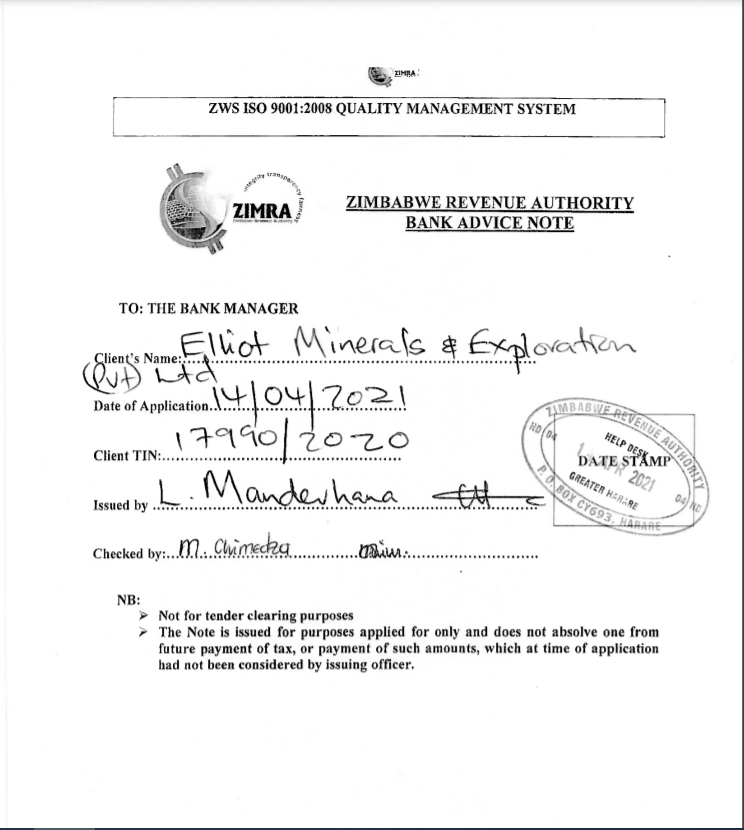
Bank Advice Note for Elliot Minerals and Explorations

The bank advice note is the first step in getting a corporate bank account for the purposes of getting a ZIMRA Tax Clearance Certificate. The purpose of the bank advice note is to inform bankers of your company’s name, location, and directors.

The process of getting a bank advice note

1. Register your company

The first step in your new account is to register a company. We can take care of that for you.  Contact us here for assistance with company registration.  This way you will automatically be able to comply with local regulations and start the process.


Apply for a bank advice note

Apply for a bank advice note. According to Zimbabwean law, you need to have a tax clearance certificate to open a company bank account. Since it’s not possible to get tax clearance without a bank account, the tax authority, therefore, makes a special authorization to the bank that allows for new companies to be able to open a business account without tax clearance. This is what is called a bank advice note or simply a bank opening letter. The process requires your original company papers.

What to do after obtaining a bank advice note?

The next step is to visit your bank account with the bank opening letter or bank advice note and the bank account opening requirements below…

Bank account opening requirements

The requirements for opening a company bank account in Zimbabwe differ from bank to bank but these are the general requirements:

  • Memorandum and articles of association (applicable to Private Limited Companies only).
  • Certificate of incorporation (applicable to Private Limited Companies only).
  • CR14 (applicable to Private Limited Companies only).
  • CR6 (applicable to Private Limited Companies only).
  • Incorporation statement (only applicable to Private Business Corporations).
  • Directors’ ID’s and proof of residence in the form of a utility bill like water, phone or electricity bill.
  • Passport size photos.

We recommend using BancABC,  CBZ, Agribank or Nedbank if you’re in Zimbabwe.

Do an initial deposit

Once you have your bank account available, you need to pay the initial deposit in order to activate your account.

Conclusion

There are three main steps in order to set up a new bank account: registering your company, getting a bank advice note, and finally, opening the corporate bank account then a tax clearance certificate. It is important to note that bank accounts can be used for numerous purposes, including purchasing things online without having to pay cash or wait for wire transfers. The steps may seem very different depending on who you speak with or what bank you are with. But if you understand the process behind each one, you should be able to navigate them successfully no matter which bank you might be working with.


Need a bank advice note, order here: