




01
INTRODUCTION
How to apply and win tenders in Zimbabwe this 2024
Here is a step to step guide on how to apply and win tenders in Zimbabwe this 2024. This is what they will not teach you in college or any school of business. To apply and win tenders, just make sure: you have a registered company, a valid Tax Clearance Certificate, PRAZ certificate, NSSA certificate, a vendor number, a detailed company profile, signed recommendation letters and follow the few other tricks that we’ll layout in this guide. Applying and winning tenders is as easy as copy and paste.
What is a tender?
In the first place, you may wanna know what a tender is? In simple terms, a tender is a formal request by a certain company to get a specific supplier to carry out a specific task or deliver certain goods , at a stated place and within a specific time frame. Please take the word specific time frame religiously! Most companies do not win tenders simply because they do not state their delivery period. Go through this document so you can learn how to apply and win tenders in Zimbabwe.
How much can I get from a tender?
By no doubt, a tender means big money! Whilst there is no specific amount of how much you can earn from winning a tender, be guided accordingly by these minimum thresholds:
(i) Goods- USD 10 000 or equivalent at bank rate.
(ii) Services – USD 5 000 or equivalent at bank rate.
(iii) Works (such as renovations, construction) USD 20 000 or equivalent at bank rate.
This is in accordance with the Procurement Regulatory Authority of Zimbabwe (PRAZ). The amount you can get if you apply and win a tender differs. Some tenders may give you upto USD 100m. At some point, you can win a tender for supplying say stationery or toiletries for the whole year. Imagine supplying toiletries to Zimbabwe Electrical Supply Authority (ZESA) or supplying stationery to NetOne. Winning a tender means big money!
Where to get tenders?
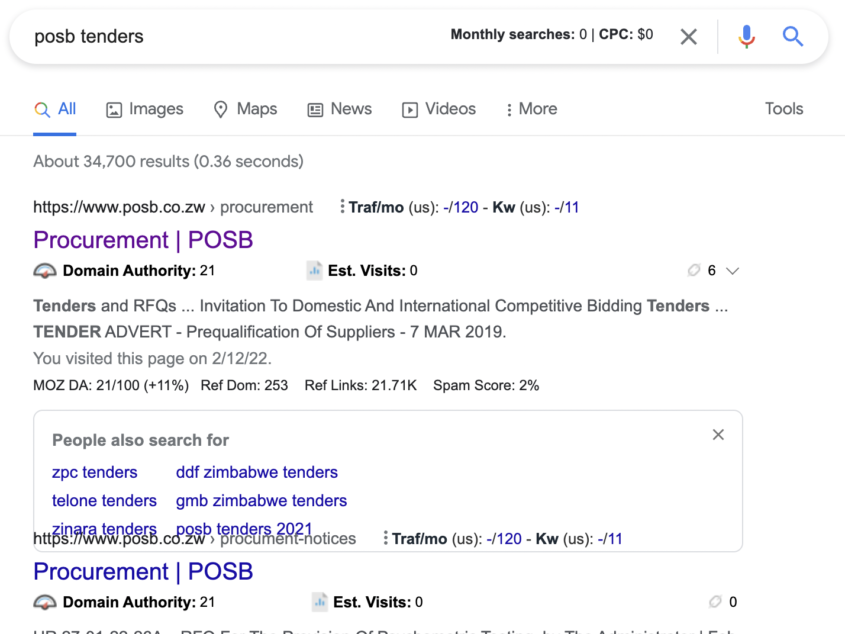
Approximately, hundreds and hundreds of tenders are being flighted on the local press. Most of them are flighted in the Sunday Mail, Thursday Herald or Financial Gazette. Those willing to apply for government tenders, you can check the Government Gazette as well. Due to technological advancements, you can also get tenders from corporate websites, other tender-listing websites like: www.tendernoticeboard.co.zw or https://tendertube.co.zw/ etc. To check tenders on a company website, just type the name of the company + tenders. Example: Zinara Tenders or POSB tenders. Other companies are just putting a very short advert in the press and share a link to their website for full details.
02
STEPS TO WIN A TENDER
What are the steps in applying for a Tender?
To apply and win tenders, you have to:
(i) thoroughly read the tender and see if it’s applicable to your line of speciality. Some tenders maybe marked as domestic tenders and that means the tender is open to the residents of that specific region only. For example, Buhera Rural District council can flight a domestic tender that is limited to Manicaland Province companies only.
(ii) check if the tender is still valid and whether you can or cannot meet the delivery period. If you come across a tender with a tight deadline that you cannot meet, you better leave it. We however advise you to try all the possible means to increase your workforce, capital or any other economic resource in the short run so you can deliver.
03
INTRODUCTION
Documents required to apply and win tenders.
Here is a list of the documents that will be required when applying for a tender in 2024. Note that this list shares the common documents that are requested. At some point in time, there may be extra documents required or some documents we have listed below may not be required.
1. Company registration documents
These documents are a prerequisite when applying for a tender. They include Certificate of Incorporation, CR 5, CR 6, Memorandum and Articles of Association. Companies that were registered before February 2020 may show CR 6 and CR 14 instead of CR 5 and CR 6 respectively. Of you do not have Company Registration documents, please get in touch with us :+263716196475 | +263777069078. Check more about why you must register a company here… We advise you to make sure that all shareholders and directors’ details are upto date. Should you need any changes to your company registration documents, please get in touch as well.
2.Tax Clearance Certificate
This is another prerequisite when applying for tenders. A tax clearance certificate shows that you are paying your taxes to the government. If you don’t have a Tax Clearance Certificate, it means you will lose 30% of your earnings as Withholding tax by the government. Example, you wanna sign a deal of 100 000 but you do not have a Tax Clearance Certificate, it means you’ll lose $30 000. In most instances, you’ll lose the deal entirely of you do not have a tax clearance certificate. If you do not have a tax clearance certificate, please get in touch with us so we can process one for you. Remember to check our document on how to obtain a Tax Clearance Certificate in Zimbabwe…
3.Business bank account
This is where your funds will be deposited once you win the tender. At no point in time will a tender be awarded to a company without a bank account. Check out how you can open a corporate bank account in Zimbabwe here. Make sure you type the correct account number and branch codes when applying for a tender. Mistakes are costly. Do things right at the first time.
4. PRAZ Registration.
The Procurement Regulatory Authority of Zimbabwe (PRAZ) is the arm of the government that governs how tenders are flighted, selection process etc. When applying for government tenders, PRAZ Registration is a prerequisite. Register for PRAZ here…
5. Vendor Number
If you want to apply and win tenders from the government, you are obliged to have a vendor number. You maybe wondering what a vendor number is? It’s a unique code, usually 5-digits that you’re assigned by the Ministry of Treasury. It’s use of for you to get paid by the Ministry of Finance whenever you have supplied something to the ministry. We covered the vendor number application process on this blog.
6. Detailed company profile.
A detailed company profile helps you stand out from the crowd! Make sure you keep your Company profile updated to reflect the requirements of the specific tender.There is no one size fits all in business. What must be included in the company profile: Company name, physical address, phone numbers, email address, list if products and services on offer, key projects you have done, details of key personnel and their qualifications, payment details (bank account, branch code etc). Make sure you document whatever is necessary as per tender requirements. The art of winning tenders is by following instructions like you’re carrying arm orders. In case your company profile is not updated, get in touch with City Cloud Private Limited. They’re the best web and graphic designing agency we have dealt with so far.
7. Trade references.
From our experience, to apply and win tenders, you must have trade references that are signed and stamped. Trade references serve the purpose of making sure you have supplied the same items before. They help you become more authentic and increase your chances of winning the tender. Make sure the contacts on your trade references are reachable.
8.NSSA Certificate:
A NSSA Clearance Certificate is a certificate issued by the National Social Security Authority [NSSA] to registered employers liable for NSSA contributions, under any of the Acts administered by the National Social Security Authority. The certificate is issued upon request from employers whose contribution accounts are up-to-date or has made alternative debt settlement arrangement with NSSA.
What are the benefits of NSSA Clearance Certificate?
NSSA Clearance Certificate is required when bidding for tenders.
It acts as an assurance that, the trading partner’s employees are adequately covered by social security schemes as enshrined under Section 12 of the Accident Prevention & Workers’ Compensation Scheme SI 68 of 1990.
A NSSA Clearance Certificate is a pre-requisite when applying for licences issued by local authorities.
Business counterparts have confidence in doing business with companies who are compliant to statutory obligations
What is required to obtain a NSSA Clearance Certificate?
The Employer’s account must be up-to-date in terms of contributions & premiums.
Employers with outstanding legacy debt, must make alternative debt settlement arrangement, approved by NSSA.
The Employer must furnish all statutory returns particularly P4 return or make satisfactory arrangements with NSSA for the furnishing of such returns.
Contact our team if you need assistance with NSSA Certificate: +263716196475 | +263777069078
9.Bid Security
It is also known as a bid bond. This is a refundable fee that you pay as a security. This is done to avoid suppliers who win tenders and fail to deliver.The bid security shall be payable through the below options:
First Option…………. A certified bank cheque; or
Second Option………A bank guarantee from a commercial bank;
Third Option…………A cash deposit to the Procurement Regulatory Authority of Zimbabwe (PRAZ) – If the third option is chosen, bidders must also submit proof of payment of non-refundable Bid Bond Establishment fees in terms of the section 90 part IV of the S. I 5 of 2018. The amount payable to PRAZ as non- refundable cash bid bond establishment differs. Any bid not accompanied by a Bid Security where this is a requirement of bidding, will be rejected by
the Procuring Entity as non-responsive.
10.Declaration of corrupt practises.
Most companies now require you to declare that you have not been involved in any corrupt activities and you’ll not even do so. A sample of a declaration of corrupt activities takes this form:
We at [your company name] do hereby declare that we do not egage in any corrupt activities.
Signed: [Company secretary or any other signatory]
Please note that most companies take the declaration of corrupt activities seriously and failure to declare that you’re corrupt means automatic disqualification. Make it a habit to include this even if it’s not mandatory.
The Government of Zimbabwe requires that Procuring Entities, as well as Bidders and Contractors,
observe the highest standard of ethics during the procurement and execution of contracts. In pursuit
of this policy: the Procuring Entity will reject a recommendation for award if it determines that the Bidder
recommended for award has, directly or through an agent, engaged in corrupt, fraudulent,
collusive or coercive practices in competing for the Contract or been declared ineligible to be
awarded a procurement contract under section 99 of the Act;the Authority may under section 72 (6) of the Act impose the sanctions under section 74 (1) of the Regulations; and any conflict of interest on the part of the Bidder must be declared.
Tender application checklist
Inorder to apply and win tenders, have a checklist so you will not ommit important items. Here is a checklist you can ammend to fit yours:
Tenders are an opportunity for your company to showcase itself and to demonstrate that you have what it takes to be considered as a potential supplier. It is not easy to win a tender. However, with proper preparation, you can increase your chances of winning.
One of the main reasons why companies lose tenders is that they do not always meet the requirements set out by the client. To make sure that you get shortlisted for the next round, it is important that you understand what the client is looking for. This will help you to complete your proposal in a way that addresses the client’s needs and demonstrates how your company can meet their requirements.
This guide has given you all the steps of writing a successful tender application in 2024 and give you practical tips on how to write a winning proposal.We wish you all the best in your business.
Our contact details: +263716196475 |+263777069078 | info@companyregzim.co.zw
Registering a Company in Zimbabwe is quite an easy task. In this guide, we give you the easy to follow steps in registering a company in Zimbabwe, the documents you will obtain, how to be in compliance with the Tax Laws and any other documentation needed.
Welcome to our comprehensive guide on registering a company in Zimbabwe. If you’re planning to start a business in this vibrant country, it’s crucial to understand the necessary steps and requirements involved in the registration process. This article serves as your ultimate checklist, ensuring that you don’t miss a thing when registering a company in Zimbabwe in 2024.
Before proceeding with the registration process, it’s essential to determine the most suitable business structure for your venture. Zimbabwe offers various options, including sole proprietorships, partnerships, private limited companies, and public limited companies. Each structure has its own advantages and considerations, so it’s important to carefully assess your business goals, liability concerns, and growth plans before making a decision.
Once you have decided on a business structure, the next step is to reserve a unique name for your company. The Companies and Other Business Entities Act of Zimbabwe stipulates that the proposed name must not be identical or similar to an existing company’s name. Check our detailed guide on Company name search in Zimbabwe.
Registering a company in Zimbabwe can seem like a daunting task, but it doesn’t have to be. The process can be broken down into a few simple steps. Firstly, the company name must be approved by the Registrar of Companies. Once the name is approved, the company’s memorandum and articles of association must be prepared and submitted to the Registrar.

Company Registration Prices in Zimbabwe
Drafting the Memorandum and Articles of Association is a crucial aspect of the registration process. The Memorandum outlines the company’s objectives, while the Articles of Association define its internal regulations and procedures. Seek professional assistance to ensure these documents are accurately prepared and comply with the legal requirements in Zimbabwe.
Determining the share capital and shareholders of your company is an important step. Share capital refers to the total value of shares issued by the company, while shareholders are individuals or entities who hold these shares. Consider the ownership structure, voting rights, and distribution of dividends when allocating shares to shareholders. It’s crucial to maintain detailed records of shareholders and their respective holdings.
In Zimbabwe, companies are required to have at least one director and a company secretary. Directors are responsible for managing the company’s affairs and making strategic decisions, while the company secretary ensures compliance with statutory obligations and handles administrative tasks. Ensure that the appointed individuals meet the eligibility criteria set by the Companies and Other Business Entities Act.
To operate legally in Zimbabwe, your company must register for tax purposes and obtain the necessary licenses and permits. Familiarize yourself with the tax laws and regulations to ensure compliance and avoid any potential penalties. It’s advisable to engage a qualified tax consultant who can guide you through the process and help you optimize your tax obligations. Let us help you manage your tax affairs. Contact us: +263716196475 | +263777069078
If your company plans to hire employees, it’s important to understand the employment regulations in Zimbabwe. Familiarize yourself with labour laws, minimum wage requirements, and employee benefits to ensure a smooth and compliant hiring process. Establish proper employment contracts and maintain accurate records of employee information.
Protecting your intellectual property is crucial for the long-term success of your business. Registering trademarks, patents, and copyrights can safeguard your unique ideas, inventions, and creative works from unauthorized use. Consult with intellectual property professionals to navigate the registration process and ensure comprehensive protection for your assets.
Once your company is registered, you must adhere to ongoing compliance and reporting requirements. This includes filing annual returns, maintaining updated registers, and submitting financial statements to the relevant authorities. Failure to comply with these obligations can result in penalties or even the deregistration of your company. It’s wise to engage a consultant who manages your secretarial work : filing annual returns, maintaining updated registers, and submitting financial statements to the relevant authorities. Let us help you with all company secretarial work. Ring us on: +263716196475 | +263777069078
Congratulations! You’ve now familiarized yourself with the ultimate checklist for registering a company in Zimbabwe in 2024. By following these steps and ensuring compliance with the legal and regulatory frameworks, you’ll be on your way to establishing a successful business in this dynamic country. Remember, seeking professional advice and assistance throughout the registration process can significantly contribute to the smooth operation of your company.